

Paint Correction for Supercars in West London: Our Step-by-Step Process
When a Ferrari rolls into our bay at Edith Grove, or a Lamborghini owner from Knightsbridge calls to book in for a full paint correction, the first thing we do is take a breath and look at the car properly really look at it. Because paint correction on a supercar is not something you rush, and it is certainly not something you guess your way through.
We are the AP Car Spa team have built our reputation working on some of the most extraordinary vehicles in West London from Mayfair to Putney, Kensington to Battersea. In this guide, we walk you through our entire paint correction process: the preparation, the products, the technique, and why it genuinely matters for the long-term value of your vehicle.
What Is Paint Correction And Why Does a Supercar Need It?
Paint correction is the process of permanently removing imperfections from a vehicle's clear coat the transparent protective layer that sits on top of the colour base coat.
These imperfections include swirl marks from improper washing, fine scratches, water spot etching, bird dropping damage, buffer trails, and oxidation. On a standard road car, you might barely notice them. On a supercar, they are impossible to ignore.
Supercar manufacturers Ferrari, Lamborghini, McLaren, Porsche, Aston Martin, and Bentley apply softer, thinner lacquer finishes than mass-market vehicles. This creates a deep, jewel-like gloss that defines the car's appearance. The trade-off is that this soft lacquer is far more susceptible to marring and scratching. It shows every imperfection clearly, especially in direct sunlight.
Paint correction is not a cosmetic luxury. For a supercar worth £150,000 or more, degraded paintwork can meaningfully reduce resale value and undermine the visual statement the car is designed to make.
Our clients across Fulham, Battersea, and Putney trust us to restore their vehicles to a standard that surpasses the factory finish and to protect that finish so it lasts.
Step 1: Initial Paint Assessment and Thickness Readings
Reading the Car Before We Touch It
Every paint correction at AP Car Spa begins with a comprehensive assessment. Before a single product touches the paintwork, we carry out:
Paint depth gauge readings: taken at multiple points across every panel. This tells us exactly how much clear coat is present and how much we can safely remove during correction. This step is non-negotiable it protects our clients from over-polishing and protects the car from irreversible damage
Visual inspection under LED lighting: we use a combination of raking LED inspection lamps and direct overhead lighting to identify the full extent of swirl marks, scratches, holograms, and oxidation across every panel
Panel-by-panel assessment: different panels often tell different stories. A front bumper may have stone chips and insect etching; the roof may have wash marring; the door shuts may have transfer marks. We map every defect before we begin
This level of diligence is what separates professional paint correction from the kind of machine polishing done by someone with a DA polisher and a YouTube tutorial. On a McLaren Artura or Aston Martin DB12, an uninformed approach causes more harm than good.
Step 2: Decontamination and Safe Wash
Preparing the Surface for Correction
Attempting paint correction on a contaminated surface is a fundamental mistake. Before any polishing machine comes near the car, we carry out a full decontamination wash process:
Pre-Wash Snow Foam
A pH-neutral snow foam we use Koch-Chemie Green Star or Gtechniq W1 depending on the vehicle is applied via foam lance and left to dwell for several minutes. This softens and lifts loose contamination: road film, brake dust, and airborne pollutants. For vehicles arriving from Mayfair or Kensington, the level of traffic-related fallout on the paintwork is consistently significant.
Iron Fallout and Tar Removal
Following the foam stage, we apply a dedicated iron fallout remover (CarPro Iron X or Koch-Chemie Reactive Nano Lotion) across the bodywork. You can visibly watch the product react and turn purple as it draws dissolved iron particles deposited by brake dust from London traffic out of the lacquer. Tar deposits from road surfaces are removed with a solvent-based tar remover, applied carefully by hand.
Clay Bar Decontamination
Even after chemical decontamination, bonded particles remain on the surface that washing cannot remove. We use a professional-grade clay bar or clay pad Gyeon Q2M Clay, AutoScrub Fine, or similar lubricated with a spray detailer, to mechanically remove this final layer of contamination. The result is a surface that feels glass-smooth to the touch and is genuinely ready for polishing.
Final Rinse and Panel Wipe
The car is thoroughly rinsed and dried using plush Korean microfibre drying towels never chamois leather, which can scratch. Panels are then wiped with an IPA (isopropyl alcohol) solution to strip any remaining polish residue, wax, or oil. Now, and only now, are we ready to correct the paint.

Step 3: Choosing the Right Machine, Pad and Compound
Not Every Supercar Responds the Same Way
This is where professional knowledge is everything. The choice of machine, cutting pad, and compound must be matched to the specific paint system of the vehicle. A product combination that works beautifully on a Porsche 911 GT3 may be entirely wrong for a Ferrari Roma and using the wrong combination risks burning through the lacquer or leaving behind holograms that require further correction.
Rotary Polishers Power and Precision
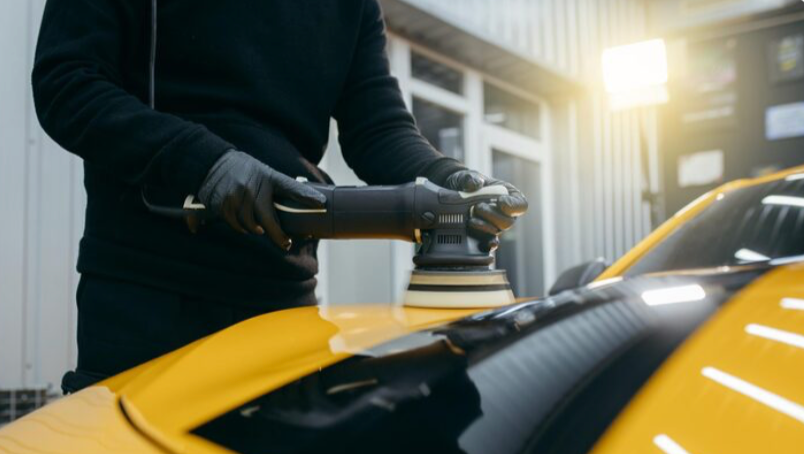
For more severe correction work heavy swirl marks, deeper scratches, and paint that has suffered significant degradation we use a rotary polisher. In our team's hands, a Rupes LHR 21 Mark III or Flex PE14-2 rotary delivers the cutting power needed to level the clear coat efficiently. Rotary machines generate more heat and require a higher level of skill, in inexperienced hands they will cause irreversible damage. This is why they are a professional tool, not a home detailing option.
Dual-Action (DA) Polishers Safer and Incredibly Effective
For the majority of correction work on supercars including most Ferrari, McLaren, and Lamborghini paintwork we use a forced-rotation dual-action polisher. The Rupes BigFoot LHR 15 Mark III is our primary tool. The DA motion reduces heat generation and dramatically lowers the risk of burning through thin lacquer. It is the safest route to a high level of correction on soft, sensitive paint systems.
Pad Selection Matched to the Task
Heavy-cut foam or microfibre pad: used with a cutting compound for aggressive correction (Meguiar's M105, Gtechniq P1 Heavy Cut)
Medium-cut foam pad: used with a medium compound for moderate swirl removal (Koch-Chemie Micro Cut, CarPro Reflect)
Finishing pad: used with a fine finishing polish (Menzerna Super Finish 3500, Gtechniq P1 Finishing) to refine the surface after correction and maximise gloss
Product Matching by Paint Type
Ferrari (Soft Italian Lacquer)
Ferrari's lacquer is notoriously soft and thin. We lean toward DA polishing with medium-cut compounds, progressing to a jewelling polish. Heavy rotary work is used only where absolutely necessary, with constant pad checks and paint thickness monitoring throughout.
Porsche (Hard German Lacquer)
Porsche uses a harder, thicker lacquer than Ferrari or Lamborghini. This allows slightly more aggressive cutting without risk, but it also means the lacquer is more resistant to polishing a higher-cut compound may be needed to achieve the same level of correction.
McLaren (Carbon-Heavy Bodywork)
McLaren vehicles present unique challenges large areas of exposed or painted carbon fibre that respond differently to polishing pressure. Edge pressure management is critical to avoid burning through on body lines and panel edges.
Aston Martin and Bentley (Premium OEM Finishes)
Both marques use high-quality factory finishes that respond well to a methodical DA correction approach. The depth of colour in an Aston Martin Zaffre Blue or Bentley Verdant can be truly spectacular once the lacquer is properly corrected and polished.
Step 4: The Correction Process, Panel by Panel
How We Work Through the Car
Paint correction is not rushed. We work systematically, panel by panel, checking our work under LED lighting after every section. Each panel goes through a minimum of two stages: cutting (to remove the defect) and finishing (to maximise gloss and eliminate any marks left by the cutting stage).
Working in a controlled environment is essential. Our Chelsea facility is enclosed and temperature-regulated exterior detailing in direct sunlight or cold conditions causes polish to dry too quickly and can introduce its own defects. Every detail we carry out takes place under controlled conditions.
A full single-stage paint correction on a supercar typically takes 6 to 10 hours. A two-stage correction cut then refine takes 10 to 16 hours. A multi-stage correction with paint restoration and finishing can take 2 to 3 full days.
Our clients from Mayfair to Battersea, Kensington to Fulham understand that this level of care cannot be compressed.
Step 5: Protection: Ceramic Coating or Paint Protection Film
Locking In the Correction
Once the paint has been corrected and the finish is at its best, we always recommend an immediate application of protection. Leaving a corrected supercar unprotected means the environment London roads, bird droppings, rain, and traffic fallout will begin undoing the work within days.
Ceramic Coating for Supercars
A professional-grade ceramic coating Gtechniq Crystal Serum Ultra, CarPro Cquartz Finest Reserve, or IGL Coatings Kenzo bonds chemically to the lacquer and creates a semi-permanent layer of protection that lasts 3 to 5 years. It provides:
Extreme hydrophobic properties water sheets off rather than sitting on the surface
Chemical resistance against bird dropping acids, rain, and road salt
Significantly enhanced gloss depth, especially on deep, dark colours
Easier maintenance washing the surface repels dirt and contamination
Paint Protection Film (PPF)
For maximum long-term protection particularly on high-impact areas such as the bonnet, front bumper, sills, and wing mirrors Paint Protection Film is the definitive solution. PPF self-heals minor surface scratches from heat and prevents stone chips from ever reaching the lacquer. We work with XPEL Ultimate Plus and Hexis Bodyfence, cut and installed to each vehicle precisely.
See more information on PPF vs Ceramic Coating visit here our article in The Journal

The Investment Case - How Paint Correction Affects Supercar Value
We work with supercar owners and collectors across Knightsbridge, Kensington, and Mayfair who view their vehicles as financial assets as much as driving machines. The condition of a vehicle's paintwork is one of the primary factors assessed at auction, during private sale, and by specialist dealers. Degraded paintwork, swirl marks, and uncorrected scratches all reduce sale value often by more than the cost of professional correction and protection.
A fully corrected and ceramic-coated supercar also carries a measurable uplift in kerb appeal. When a vehicle is presented at a Chelsea or Knightsbridge event, or photographed for a listing with Hexagon Classics, JCT600, or HR Owen, the standard of its paintwork is immediately visible.
We have seen paint correction and protection services recover multiple thousands of pounds in resale value for our clients. The cost of professional care is never wasted on a vehicle worth protecting.
Maintaining the Finish: Ongoing Supercar Care Across West London
Paint correction is not a one-time event. A corrected and protected supercar still requires consistent, professional care to maintain the result. We recommend the following ongoing programme for our clients in Chelsea, Fulham, Putney, Battersea, Kensington, and Knightsbridge:
Monthly maintenance wash: a contact wash using proper two-bucket method and pH-neutral shampoo, followed by a ceramic coating topper spray to refresh the hydrophobic layer
Quarterly inspection detail: a thorough inspection, panel wipe, decontamination if needed, and coating maintenance treatment
Annual correction assessment: we inspect paint thickness and surface condition annually to identify any new defects early before they deepen and require more aggressive correction
Ceramic coating reapplication: depending on the product tier applied, a full recoat every 3 to 5 years is recommended to maintain maximum protection
Owners who use our car storage service benefit from significantly reduced exposure to environmental contamination between uses meaning their paint stays cleaner, longer, and requires less intensive maintenance correction over time. Learn more about our secure car storage for supercars in Chelsea here
Serving Supercar Owners Across West London
Knightsbridge, Kensington, Mayfair, Chelsea, Fulham, Battersea & Putney
Our location at Chelsea London Car Park, Edith Grove, is uniquely positioned to serve the most concentrated cluster of supercar ownership in the United Kingdom. Within a short drive of our facility you will find:
Knightsbridge: home to some of London's most exclusive residences and a high density of Rolls-Royce, Bentley, Ferrari, and Lamborghini ownership
Kensington: where prestige garages and private mews properties shelter extraordinary collections of modern and classic performance vehicles
Mayfair: London's most prestigious postcodes, with clients ranging from private owners to hedge fund managers and international collectors
Fulham: a growing base of McLaren, Porsche, and Aston Martin owners who demand the same level of care as their SW7 and W8 neighbours
Battersea: the Nine Elms development has brought a new generation of supercar owners to the south bank all within 10 minutes of our Chelsea facility
Putney: a strong community of Porsche, Ferrari, and Range Rover owners who value the same professional-grade service we deliver to clients across the river

If you own a supercar, hypercar, or prestige vehicle anywhere across London we are your car detailing specialist. We collect and deliver vehicles by appointment for clients who prefer not to drive to us directly.
Book Your Supercar Paint Correction at AP Car Spa
Schedule your assessment today book-online or read what our clients say about our work reviews.
Our team is ready to assess your vehicle, discuss the level of correction required, and provide a transparent, detailed quote. We do not cut corners. We do not rush. We take every vehicle as seriously as its owner does because in our view, a properly corrected and protected supercar is one of the most satisfying things in the world of automotive care.
AP Car Spa | Chelsea London Car Park, Edith Grove, London SW10 0ED | apcarspa.co.uk


Comments