

Alloy Wheel Refurbishment for Luxury & Exotic Cars
Updated: Jun 1
Your wheels are never an afterthought. On a Lamborghini Huracán, a Rolls-Royce Cullinan, or a concours-prepared Porsche 911, the condition of the alloys tells a story the moment the car is seen. Scuffed rims, peeling lacquer, corrosion creeping in from the barrel these details do not go unnoticed by the people whose opinions matter most: discerning buyers, collectors, and anyone who truly understands what a prestige vehicle should look like.
At AP Car Spa in Chelsea, our luxury alloy wheel refurbishment service is one of the most exacting processes we carry out. It demands the same attention to detail, the same product knowledge, and the same uncompromising standard as our paint correction and ceramic coating work because a perfectly detailed car sitting on poorly finished wheels is a contradiction we simply will not allow to leave our facility.
In this guide, we walk through our full refurbishment process, the techniques and materials involved, the different wheel types we work with, how long the process takes, and why it represents genuine long-term value for the owner of any high-end vehicle.

Why Wheel Refurbishment Matters for High-End Vehicles
Wheels Define the Finished Appearance of Your Car
Kerb damage, brake dust staining, corrosion blistering, and lacquer peel are unavoidable realities even on vehicles that are driven with considerable care on London's roads. In Kensington, Chelsea, and Mayfair, tight parking bays and raised kerb stones make wheel damage almost inevitable over time. The question is not whether damage will occur, but how professionally it is addressed when it does.
On a standard car, scuffed wheels are an inconvenience. On an Aston Martin or a Ferrari Roma, they are a visible blemish on a work of automotive art. The wheels on these vehicles are not commodity components they are often forged aluminium, multi-piece, multi-spoke designs that are integral to the aesthetic identity of the car. They deserve specialist treatment, not a sand-and-spray job from a high street tyre fitter.
The Resale Value Argument
For our clients across Knightsbridge, Mayfair, and the wider West London area who view their vehicles as financial assets, wheel condition is a meaningful factor at the point of sale. A concours-condition Porsche 911 GT3 RS with kerbed and corroded rims immediately raises questions among specialist buyers and at auction. Conversely, a set of flawlessly refurbished wheels properly colour-matched, lacquered, and finished signals meticulous ownership and commands a premium.
We have seen wheel refurbishment directly influence the price achieved at specialist auction and in private sales. For vehicles worth six or seven figures, the cost of a professional wheel restoration is always a sound investment.
We work with private collectors, prestige dealerships, and concours preparation specialists across London and the South East. The standard we hold ourselves to is the standard those clients require: zero margin for error.

Understanding the Different Types of Alloy Wheels We Work With
Not All Wheels Are Equal, And We Treat Them Differently
Before we describe our process, it is worth explaining the different categories of alloy wheel we encounter on the prestige vehicles we service. Each type demands a distinct approach and a premium refurbishment specialist must know the difference.
Standard Painted Alloy Wheels
The most common type on prestige vehicles the wheel is finished in a solid colour (gloss black, anthracite, silver, or a bespoke body-matched colour) with a protective clear lacquer over the top. Damage to the lacquer or paint is addressed through chemical stripping, surface preparation, and a full repaint in the original or specified colour.
Diamond-Cut Alloy Wheels
Increasingly popular on prestige marques Range Rover, Mercedes-AMG, BMW M Series, Audi RS diamond-cut wheels feature a machined face that has been cut on a CNC lathe to produce a highly polished, reflective metal surface, with the rest of the wheel finished in a complementary colour. Refurbishing these wheels correctly requires access to a CNC lathe and the skill to re-cut the face to the precise original profile. This is a specialist process that cannot be replicated by hand and takes years to master. Attempting diamond-cut refurbishment without the right machinery produces a result that looks immediately wrong on a high-end vehicle.
Forged and Multi-Piece Wheels
Found on supercars, GT cars, and limited-edition models, forged wheels by manufacturers such as HRE, Brixton Forged, OZ Racing, and AP Racing are typically lighter and structurally stronger than cast alloys, and significantly more expensive to replace. Damage to a forged wheel is treated with additional caution: structural inspection takes precedence over cosmetics, and any sign of stress fracture or crack means the wheel is deemed unfit for refurbishment and the owner is advised accordingly.
Powder-Coated Wheels
Some vehicles arrive with previously powder-coated wheels often a modification or previous refurbishment. These require full strip-back to the bare alloy before any new finish is applied, as applying additional coatings over existing powder coat creates adhesion failure over time.
Our Alloy Wheel Refurbishment Process:
Step by Step
Step 1 Initial Inspection and Structural Assessment
Every refurbishment begins before a single tool is picked up. We carry out a thorough inspection of each wheel under proper workshop lighting, checking:
Structural integrity: we examine the barrel, spokes, and rim lip for stress fractures, impact damage, or cracks. A visually damaged wheel may be repairable cosmetically but if structural integrity is compromised, it is unsafe to refit regardless of how good the finish looks. We will always advise the owner directly if this is the case
Extent of cosmetic damage: kerb damage depth and profile, lacquer peel, corrosion blistering, brake dust staining, and any evidence of previous substandard repairs are all documented
Factory finish specification: for vehicles such as Rolls-Royce, Bentley, and Aston Martin, we identify the original manufacturer paint code and finish specification before any work begins. Where necessary, we use spectrophotometry to achieve a precise colour match
Tyre condition: we note the condition and specification of the tyres before removal, particularly important for vehicles fitted with performance rubber such as Pirelli P Zero Corsa, Michelin Pilot Sport Cup 2, or Bridgestone Potenza tyres
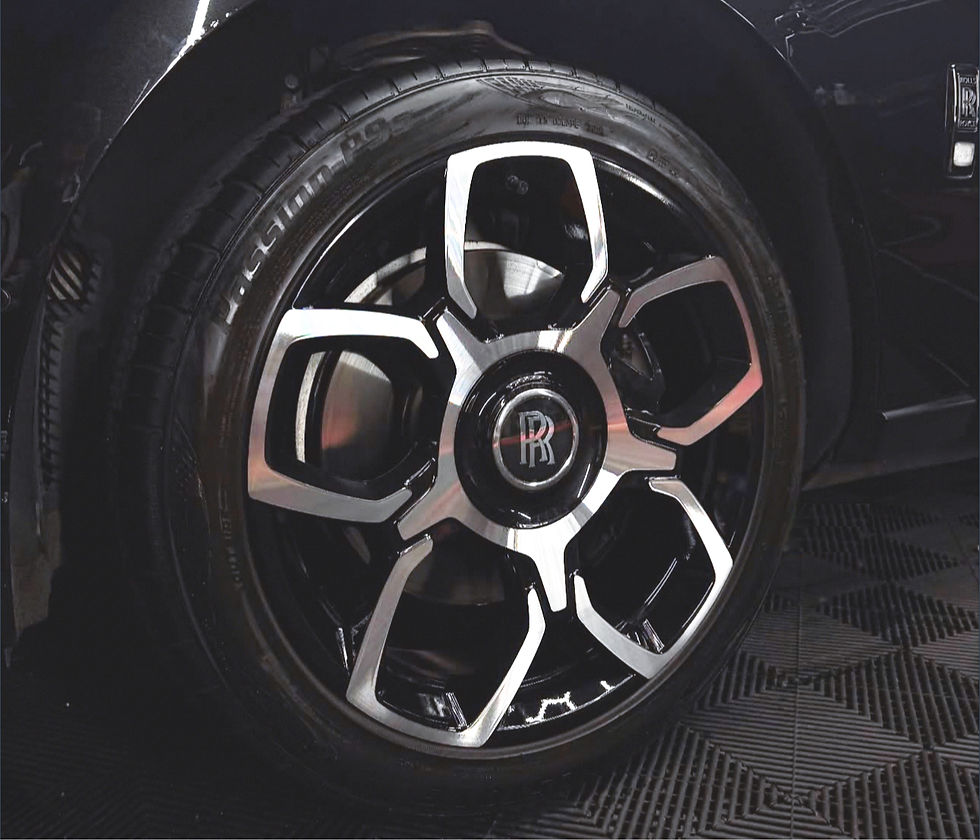
Step 2 Safe Tyre Removal and Storage
Tyres are removed using calibrated equipment to prevent bead damage a particular concern with low-profile, high-performance tyres which have minimal tyre wall flexibility and can be damaged by improper handling. Each tyre is labelled with its wheel position and stored safely throughout the refurbishment process. This matters: refitting tyres to the correct wheel position preserves the wear pattern and balance characteristics established during normal use.
Step 3 Strip Back and Full Surface Preparation
This stage is where the quality of a refurbishment is truly determined and where the difference between a professional and a budget repair is most visible, even if only seen later when the finish fails.
Chemical Strip
We use a professional-grade chemical stripper to remove all existing lacquer and paint from the alloy surface. Chemical stripping is gentler and more controlled than blasting it does not abrade or stress the alloy surface, which is important for maintaining the structural and dimensional integrity of forged and precision-cast wheels.
Grit Blasting (Where Required)
For heavily corroded wheels or those with deep oxidation at the barrel or spokes, controlled abrasive blasting is used to remove corrosion and expose clean alloy. Blast media and pressure are matched to the alloy type we do not use the same aggressive parameters on a lightweight forged wheel as we would on a heavier cast alloy.
Hand and Machine Sanding
The stripped surface is worked through multiple grit stages from coarse through to fine using a combination of hand sanding and orbital machine sanding. This produces the smooth, even profile that is essential for a flawless final finish. Any remaining surface irregularities are revealed and addressed at this stage.
Precision Damage Repair
Kerb damage, gouges, and deep scratches are repaired using specialist alloy filler, shaped by hand to precisely match the original profile of the wheel. This is a skilled, time-consuming process particularly on multi-spoke designs where each spoke profile must be individually reconstructed. We do not smooth over damage; we repair it to the original specification.
CNC Diamond-Cut Machining
For diamond-cut wheels, the prepared wheel is mounted on our CNC lathe and the face is re-cut to its original manufacturer specification. This removes the previous polished face entirely and creates a new, perfectly flat and reflective surface. Millimetre-level accuracy is required a poorly set CNC cut produces visible inconsistencies in the wheel face that cannot be corrected without re-cutting. This is a process that demands both the right machinery and experienced hands at the controls.
Step 4 Priming and Basecoat Application
With the surface fully prepared, we apply:
Self-etching primer: applied directly to the bare alloy to promote maximum adhesion and provide an initial protective layer against corrosion
High-build primer: applied over the etch primer to create a solid, sealed foundation for the colour coats and to reveal any remaining surface imperfections that require attention before the colour is applied
Both primer coats are applied in our controlled spray environment and allowed to cure fully before the next stage. Colour matching is carried out using manufacturer codes and, for bespoke or limited-edition finishes, spectrophotometric analysis to achieve an exact match.
Step 5 Paint Finish or Powder Coat
Depending on the wheel type and the owner's specification, we apply one of two primary finish methods:
Wet Paint Finish
Used for diamond-cut wheels (where only the non-machined areas are painted), for colour-matched bespoke finishes, and for any application where the colour specification requires close factory-matching. Wet paint allows for the finest level of colour control and is our preferred method for prestige wheel finishes requiring precise replication.
High-Quality Powder Coat
For wheels where maximum durability is the priority or where the client is specifying a colour change or enhanced finish we apply a high-quality electrostatic powder coat, cured in a controlled oven environment at the correct temperature and duration. Powder coat produces a finish that is significantly more resilient than wet paint alone: harder, more chip-resistant, and more resistant to chemical attack from brake dust and road salt. It is an excellent choice for daily-driven prestige vehicles.
Step 6 Clear Lacquer Sealing
Every wheel we refurbish regardless of the finish method receives multiple coats of high-gloss or satin clear lacquer, applied in our dust-controlled environment. The lacquer is applied in controlled stages, with each coat inspected before the next is applied. This sealing stage is critical: it protects the finish against UV, chemicals, and physical abrasion, and it delivers the deep, refined appearance that distinguishes a professional refurbishment from anything lesser.
We do not use budget rattle-can lacquers or single-stage finishes on any wheel we refurbish. Every coat we apply is a professional automotive-grade product, applied with the same discipline we bring to any painted surface on a prestige vehicle.
Step 7 Tyre Refitting, Dynamic Balancing, and Final Inspection
Tyres are refitted carefully by hand and machine, with particular attention to bead seating on low-profile performance tyres. Every refitted wheel is dynamically balanced not just static balanced to ensure there is no vibration or shimmy at speed. On a vehicle designed to travel at 180mph, balance is not optional.
Before any wheel is returned to the vehicle, it goes under our finishing lights for a final inspection. We are looking at the surface from every angle under raking light checking for any dust nibs, orange peel, colour inconsistency, or imperfection in the lacquer surface. If anything falls short of the standard, it goes back. It does not leave our facility until it is right.

How Long Does a Professional Wheel Refurbishment Take?
Proper wheel refurbishment on a prestige vehicle is not a same-day service and any facility that tells you otherwise is cutting corners in the process. At AP Car Spa, our standard turnaround times are:
Standard painted alloy wheels (set of four): 3 to 5 working days
Diamond-cut wheels requiring CNC machining (set of four): 4 to 6 working days
Forged or multi-piece specialist wheels: 5 to 7 working days depending on complexity and damage extent
Single-wheel urgent repair: available by prior arrangement please speak to us directly
These timescales reflect the curing time required between primer, paint, and lacquer stages, as well as the precision of the CNC cutting process for diamond-cut finishes.
We never compress process time to meet an artificial deadline doing so means a finish that fails prematurely, and that is not a result we are willing to put our name to.
For clients who require a quicker turnaround, we offer a priority service. Please discuss your requirements with us directly at our Chelsea premises.
The Long-Term Value of Professional Wheel Refurbishment
An Investment
For the owners of high-value, collector, and investment vehicles wheel refurbishment is not a maintenance expense it is a value-protection measure. A professionally refurbished set of wheels:
Restores resale value: particularly important for limited-edition models, concours vehicles, and cars being prepared for specialist auction or private sale
Prevents further corrosion: a properly primed, painted, and sealed alloy surface eliminates the pathways through which moisture and road salt attack the alloy substrate stopping deterioration before it becomes structural
Complements and completes other detailing work: there is little point in commissioning a full paint correction, ceramic coating, and leather restoration if the wheels undermine the finished result. The wheels are the frame of the picture they must be equal to the rest of the car
Enhances kerb presence and photographic appeal: for vehicles being sold, exhibited, or photographed, a set of properly finished wheels transforms the appearance in a way that no amount of bodywork work alone can achieve
Pairing Wheel Refurbishment with a Full Detail
Many of our clients choose to combine an alloy wheel refurbishment with a full exterior detail or paint correction service. This is the most effective way to present a vehicle at its absolute best and it is the approach we always recommend for vehicles being prepared for sale, concours entry, or long-term storage.
We sequence the work so that the wheels are completed first, refitted, and then the vehicle receives its full exterior wash, decontamination, and correction. This ensures no cross-contamination between processes and delivers a result where every element of the vehicle has been addressed to the same standard.
Learn more about our paint correction services for supercars paint-correction.
Maintaining Your Refurbished Wheels: Keeping Them Looking Perfect
The Right Aftercare Extends the Life of the Finish Significantly
A professionally refurbished and lacquered wheel will last for many years with the right care. The enemies of wheel finish longevity are brake dust, road salt, acidic wheel cleaners, and abrasive washing techniques all of which can be managed with a straightforward maintenance approach.
Use pH-Neutral, Non-Acid Wheel Cleaners
Acid-based wheel cleaners widely sold on the high street are effective at removing brake dust but are deeply damaging to lacquered alloy surfaces over time. They attack the clear coat, break down the paint, and accelerate corrosion around the barrel. We recommend pH-neutral, iron-reactive wheel cleaners (Koch-Chemie Felgen Reiniger, CarPro IronX Wheel, Gtechniq W5 Wheel Armour) that dissolve iron fallout without attacking the alloy or its protective coatings.
Avoid Abrasive Brushes and Pads
Wire brushes, stiff-bristle brushes, and abrasive sponges will mar the lacquer surface over time, creating micro-scratches that dull the finish and allow moisture ingress. Use soft-bristle dedicated wheel brushes and microfibre cloths for routine cleaning.
Apply a Wheel Sealant or Ceramic Coating
Following refurbishment, we strongly recommend the application of a dedicated wheel sealant or ceramic coating Gtechniq W2 Wheel Armour, CarPro Cquartz Wheel, or similar to the finished surface. This creates a semi-hydrophobic barrier that repels brake dust, makes weekly cleaning significantly easier, and extends the life of the underlying finish. On vehicles that are driven regularly in London, this protection is particularly valuable given the level of iron fallout on urban roads.
Rinse Wheels Frequently
For vehicles used regularly, rinsing the wheels with clean water at least weekly particularly during autumn and winter when road salt is prevalent removes the most corrosive contaminants before they have time to act on the alloy and lacquer. It takes minutes and preserves the finish for years.
Serving Prestige Vehicle Owners Across Chelsea and West London
Chelsea, Knightsbridge, Kensington, Mayfair, Fulham, Battersea and Beyond
Our Chelsea facility at Edith Grove, SW10 is at the centre of one of the highest concentrations of prestige and exotic vehicle ownership in the United Kingdom. We regularly work with clients bringing vehicles from across the Royal Borough of Kensington and Chelsea, Mayfair and Belgravia, Fulham, Battersea, Putney, and the wider South West London area.
We also work with prestige dealerships including those representing Ferrari, Lamborghini, Rolls-Royce, Bentley, McLaren, and Aston Martin on pre-delivery and pre-sale preparation, and with private collectors preparing vehicles for concours events and specialist auctions including RM Sotheby's and Bonhams.
Whether you have a single kerbed rim on a daily driver or a full set of diamond-cut wheels that need restoring to concours standard before a Goodwood entry, we treat every job with the same level of discipline and care.
Collection and delivery of vehicles is available by prior arrangement for clients who prefer not to drive to us directly. Please get in touch to discuss your requirements.
Book Your Alloy Wheel Refurbishment at AP Car Spa, Chelsea
If your wheels need attention whether it is a single kerbed rim, a full set requiring a complete colour change, or diamond-cut wheels needing CNC re-machining we would welcome the opportunity to assess the work and discuss the options with you.
We do not offer a generic, one-size-fits-all refurbishment service. Every vehicle we work on is assessed individually, every process is carried out to the full standard, and every wheel leaves our facility looking exactly as it should on the car it came from.
Book your assessment or arrange a visit to our Chelsea premises book-online
Read what our clients say about our work reviews
AP Car Spa | Chelsea London Car Park, Edith Grove, London SW10 0ED | apcarspa.co.uk


Comments